
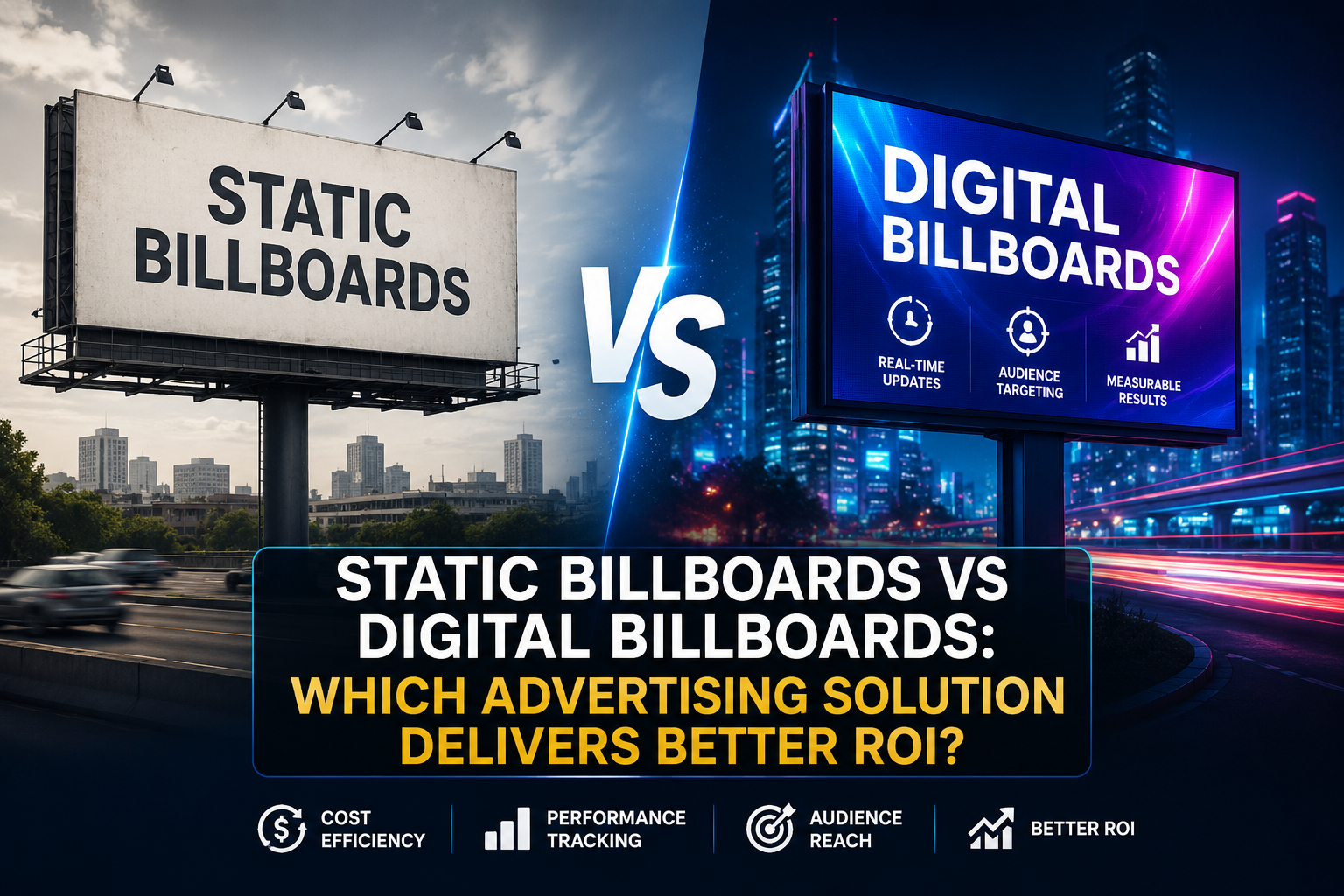
Businesses invest significant amounts in outdoor advertising, yet one question continues to divide marketers: should they choose static billboards or digital billboards? The answer is rarely universal because return on investment (ROI) depends on campaign objectives, audience behavior, budget, location, and creative execution. Understanding the strengths and limitations of each format helps advertisers make smarter decisions instead of relying on trends alone.
When evaluating outdoor advertising options, understanding how static billboards work provides valuable context because they remain one of the most widely used formats across highways, urban centers, and local communities. Comparing them with digital alternatives allows marketers to identify which solution aligns better with specific business goals rather than assuming newer technology always produces better results.
Understanding Static Billboards and Digital Billboards
Although both formats aim to reach large audiences outside the home, they operate quite differently.
Static billboards display a single printed advertisement that remains unchanged throughout the campaign duration. Once installed, the creative stays visible 24 hours a day until it is replaced.
Digital billboards use LED displays that rotate multiple advertisements every few seconds. Several advertisers typically share the same display, allowing campaigns to change quickly without replacing physical materials.
The biggest difference lies in flexibility. Static billboards prioritize consistent visibility, while digital billboards emphasize adaptability and dynamic messaging.
From an ROI perspective, neither format is automatically superior. The effectiveness depends on how well the advertising medium matches campaign objectives.
How to Choose the Right Billboard for Maximum ROI
Selecting the right billboard requires more than comparing costs. A structured evaluation leads to better long-term returns.
Step 1: Define Your Marketing Objective
Start by identifying the campaign’s primary goal.
Are you trying to:
- Build long-term brand awareness?
- Promote a limited-time event?
- Increase local foot traffic?
- Launch a new product?
- Reinforce brand recognition?
Static billboards often excel at sustained branding because repeated exposure strengthens recall over weeks or months. Digital billboards are more effective when messaging needs frequent updates.
Step 2: Evaluate Campaign Duration
Campaign length significantly affects ROI.
A six-month branding campaign may generate stronger value with static billboards since printing costs become less significant over time.
A two-week promotion, however, benefits from digital scheduling because creative can be updated instantly without production delays.
Step 3: Consider Audience Behavior
Location matters more than technology.
For example:
A highway billboard viewed daily by commuters creates repeated impressions that reinforce memory, regardless of whether it is static or digital.
Conversely, a busy downtown digital billboard can display breakfast promotions in the morning, lunch offers at noon, and entertainment advertisements during the evening.
Matching message timing with audience behavior often increases campaign effectiveness.
Step 4: Compare Total Campaign Costs
Many advertisers focus only on rental fees.
Instead, calculate:
- Production expenses
- Installation costs
- Design updates
- Campaign management
- Exposure frequency
- Duration
- Cost per thousand impressions (CPM)
A static billboard may have higher initial printing costs but lower ongoing expenses.
Digital campaigns eliminate printing costs but often involve premium placement pricing depending on location and scheduling frequency.
Step 5: Measure Performance
No billboard should be evaluated using visibility alone.
Track measurable outcomes such as:
- Website traffic increases
- Branded search growth
- QR code scans
- Coupon redemptions
- Phone inquiries
- Store visits
- Sales during campaign periods
Combining billboard performance with analytics provides a clearer picture of actual ROI.
Comparing ROI: Static vs Digital Billboards
The best-performing format varies depending on business objectives.
Brand Awareness
Static billboards often produce stronger long-term brand recall because audiences repeatedly see the same message every day. Consistency reinforces recognition over time.
Time-Sensitive Campaigns
Digital billboards have a clear advantage when promoting flash sales, seasonal events, weather-based offers, or live announcements.
Creative Flexibility
Digital displays allow advertisers to modify messaging within minutes.
Static billboards require new production and installation whenever creative changes are necessary.
Budget Efficiency
Small businesses with limited budgets frequently achieve excellent results using strategically located static billboards.
Larger organizations running multiple campaigns simultaneously may benefit from digital scheduling and rapid creative adjustments.
Audience Engagement
Digital billboards naturally attract attention because of changing visuals and motion effects.
However, attention alone does not guarantee conversions. A clear, memorable message often outperforms complex animations.
Common Mistakes That Reduce Billboard ROI
Even excellent billboard locations can produce disappointing results if campaigns are poorly planned.
One common mistake is overcrowding the design with excessive text. Drivers have only a few seconds to absorb the message, making simplicity essential.
Another frequent error involves selecting locations based solely on price. Lower-cost placements with minimal traffic rarely outperform premium locations with consistent visibility.
Many advertisers also fail to maintain message consistency across marketing channels. When billboard messaging differs from online advertisements, social media campaigns, or landing pages, potential customers may become confused.
Ignoring campaign measurement is another costly mistake. Businesses often invest in outdoor advertising without tracking whether it generates website visits, customer inquiries, or sales.
Finally, constantly changing creative without sufficient exposure can reduce brand recall. Repetition remains one of the strongest advantages of outdoor advertising.
Expert Recommendations for Better Billboard Performance
Successful billboard campaigns share several best practices regardless of format.
Keep headlines short and readable from a distance. Use a strong visual hierarchy so the primary message stands out immediately.
Focus on one clear objective instead of communicating multiple offers simultaneously.
Choose locations based on audience relevance rather than maximum traffic volume alone. A billboard reaching the right audience typically outperforms one reaching a larger but less relevant audience.
Integrate billboard campaigns with digital marketing efforts. For example, monitor increases in branded searches, direct website visits, and local conversions during the campaign period.
Regularly review campaign performance and adjust future placements using measurable data instead of assumptions.
Businesses managing multiple marketing channels should also evaluate how outdoor advertising supports overall digital visibility. Using tools like AudEsto can help analyze website performance, identify SEO improvements, and generate white-label audit reports that complement broader marketing strategies, making it easier to measure how offline advertising contributes to online engagement.
Conclusion
The debate between static billboards and digital billboards has no universal winner because ROI depends on campaign goals, budget, audience behavior, and execution quality. Static billboards continue to deliver exceptional value for long-term brand awareness through consistent exposure, while digital billboards excel when flexibility, real-time messaging, and rapid creative updates are essential.
The most successful advertisers begin by defining measurable objectives, selecting locations strategically, and monitoring campaign performance rather than choosing a format based solely on popularity. By aligning billboard selection with business goals and supporting it with strong digital measurement practices, organizations can maximize the return on every advertising dollar.